SPRINGFIELD – According to the Food Allergy Research & Education organization (FARE), 33 million Americans have a food allergy, with the most common allergies including milk, tree nuts, shellfish and peanuts. To help those having an allergic reaction, Illinoisans will soon have easier access to epinephrine under a new law championed by State Senator Mary Edly-Allen and House Assistant Majority Leader Maurice West.
“Dillon’s Law is common-sense legislation that helps our communities become better equipped to help someone experiencing an allergic reaction,” said Edly-Allen (D-Libertyville). “If a person does not know they have an allergy, they may not have access to epinephrine, which is why this law could help save so many lives.”
House Bill 2462, modeled after a law passed in Wisconsin in 2017, is named after 18-year-old Dillon Mueller, who died in 2014 after being stung by a bee without any previous knowledge of an allergy. No epinephrine was available in the first aid kits of either the Eagle Scout with him or the arriving first responders. This new law allows individuals who are properly trained to carry and administer the epinephrine to individuals having an allergic reaction.
“As the father of a daughter with a peanut allergy, I know how important it is to be prepared for allergic reactions,” said West (D-Rockford). “Dillon’s Law will help keep people safe in unexpected emergency situations and help prevent unnecessary tragedies.”
House Bill 2462 was signed into law Friday and goes into effect Jan. 1, 2026.
ArticDillon Mueller’s family has big hopes for newly introduced federal legislation that would allow good Samaritans to use epinephrine in schools to save lives. Lawmakers introduced a revised version of Dillon’s Law in the U.S. Congress in memory of the Wisconsin 18-year-old who suffered a fatal allergic reaction to a bee sting.
Wisconsin Congressman Glenn Grothman and Michigan Congresswoman Debbie Dingell reintroduced the federal bipartisan Dillon’s Law on July 22, 2025. This bill, however, takes a new approach, focusing specifically on schools.
George and Angel Mueller with Glenn Grothman (R-WI) and allergy advocate Adel Schneider.
The proposed law incentivizes states to allow any trained individual – not only trained school employees – to carry and use epinephrine devices at schools during allergy emergencies. It would provide civil liability protections to trained responders who act in good faith.
States that empower the good Samaritans would receive priority for grant funds under Dillon’s Law, which would amend the Public Health Service Act.
Grothman had introduced the legislation in 2021 and 2023. However, the earlier versions would have authorized epinephrine use in a wider range of settings.
Dillon’s mom, Angel Mueller, hopes that the new school-focused wording helps push the bill forward into law. If the revised language gains lawmakers’ support, then it will provide a base to to expand beyond school grounds in the future.
“Just having the foot in the door is really going to help,” Angel Mueller tells Allergic Living.
George Mueller, Dillon’s dad, urges the food allergy community to contact their state representatives and senators to support the federal Dillon’s Law. “I’m hopeful that the law will go through Congress this time,” he says.
Dillon’s Law: Protecting Other Families
The Muellers of Mishicot, Wisconsin have been advocating for expanded access to epinephrine since their son died of anaphylaxis in 2014. Epinephrine was not available while first responders attempted to help Dillon, who wasn’t aware he had a stinging insect allergy.
In 2017, Wisconsin became the first state to pass Dillon’s Law. Minnesota then adopted the legislation. Illinois is the latest state to move Dillon’s Law forward, passing the state House then Senate in the spring of 2025.
Angel Mueller says the training component of the law is essential. She stresses the need to understand the importance of using epinephrine quickly and how to recognize an anaphylactic reaction.
“I didn’t know about it [anaphylaxis] before Dillon died. I don’t want other families to learn about it the way I did,” she says.
The Muellers run the free “Do it for Dillon” Epinephrine Training Program in their state. Angel and George and volunteers have trained over 5,000 people in Wisconsin since launching the program.
Of the new bill, Grothman says: “This commonsense, bipartisan solution is already making a difference in our state, and it can do the same nationwide.”
“Dillon’s Law is a critical step forward in empowering trained individuals on school grounds to act swiftly and save lives,” said Dr. James Tracy, president of the American College of Allergy, Asthma, and Immunology. “Practicing allergists see firsthand how rapidly anaphylaxis can become life-threatening without immediate access to epinephrine.”
The bill has the support of allergy non-profits including the Asthma and Allergy Foundation of America (AAFA), FARE and the Allergy & Asthma Network. “By encouraging states to allow any trained individual to administer epinephrine at schools, Dillon’s Law will make it more likely that someone experiencing anaphylaxis receives emergency epinephrine when every second counts,” says Kenneth Mendez, AAFA’s CEO.
Dillon’s Legacy of Helping Others
Dillon on his dirt bike just before his prom.
Dillon, the youngest of the Muellers’ three boys, was a 2014 high school graduate, and worked on his family’s dairy farm. He earned the rank of Eagle Scout with the Boy Scouts of America, and was a member of the local chapter of the Future Farmers of America.
He loved to ride dirt bikes and snowmobiles, collecting more than 200 trophies in his racing career. His family fondly notes his love of racing around the motocross track in the cow yard.
The Muellers also remember their son’s eager willingness to help others. When he was stung by the bee, he had been helping his best friend with yard work. The teen offered to assist so the pair could get to the Homecoming game sooner, his mom recalls. The friend tried to save him by administering CPR until help arrived. Despite his efforts and those of emergency responders, Dillon did not survive.
“I think he would be very proud that we took something bad and made something good out of it. Something I’m sure he would have done,” Angel Mueller says.
His family continues to advocate for legislation to prevent more tragedies from anaphylaxis due to a lack of epinephrine access.
They will hold the 10th annual Dillon Mueller Memorial Race on September 14, 2025, raising funds for the Dillon Mueller Memorial Fund. The public is welcome to attend or to donate online. Encouraging notes and letters are also much appreciated to “keep us going,” Angel Mueller says.
Other Epinephrine Bills
Another family has introduced federal legislation during the 119th Congress session that aims to expand epinephrine access. Gio’s Law would authorize a federal grant to provide epinephrine devices and training to law enforcement officers.
The legislation, introduced in June 2025, is named for Giovanni Cipriano, 14, who died of anaphylaxis due to his peanut allergy in 2013.
In Wisconsin, another family, coincidentally also named Mueller, is advocating for legislation in memory of their son who died in November 2024. Andrew Mueller, 20, had not known he was allergic to peanuts and did not own epinephrine. He suffered a swift and fatal anaphylactic reaction after eating peanut M&M’s.
Senate Bill 156, which was introduced in their state in March 2025, would require first responders to be trained to recognize the symptoms of anaphylaxis and use epinephrine devices.
Dillon’s family is advocating for that bill, too. “We think of Andrew’s family a lot and we are behind their efforts. Their loss is weighing on us,” Angel Mueller says.le Source:
Congressman Glenn Grothman (R-WI) and Congresswoman Debbie Dingell (D-MI) have reintroduced Dillon’s Law, a bipartisan bill that incentivizes states to empower “good Samaritans” to save lives in critical moments. The legislation encourages trained individuals to administer epinephrine in schools during emergencies. Currently, the administration of this medication is limited solely to trained school employees.
Dillon’s Law is named in honor of Dillon Mueller, a native of Mishicot, Wisconsin, who tragically passed away in 2014 at just 18 years old after being stung by a bee that resulted in an anaphylactic reaction. At the time of the incident, epinephrine was not readily available and accessible.
Several states, including Wisconsin, Minnesota, and Indiana, have enacted versions of Dillon’s Law with strong bipartisan support. While Congress passed a similar measure in 2013 to support epinephrine programs in schools, this legislation expands access further by allowing any trained individual to administer epinephrine in the event of an emergency.
“We’re working to prevent more heartbreaking tragedies like Dillon’s,”said Congressman Grothman.“No parent should ever have to experience the pain of losing a child simply because lifesaving medication wasn’t available in time.
“Dillon’s Law gives states the tools to train and empower everyday people to act in emergencies and save lives. Since Wisconsin enacted a version of this law in 2017, thousands of residents have been trained to use epinephrine in life-threatening situations. This commonsense, bipartisan solution is already making a difference in our state, and it can do the same nationwide. I urge my colleagues in Congress to support this bill, honor Dillon’s legacy, and help save lives.”
“Deaths like Dillon’s are heartbreaking and preventable, and we should empower good Samaritans to save lives,” said Congresswoman Dingell. “I’m proud to introduce Dillon’s Law with Rep. Grothman to help prepare individuals to respond to anaphylaxis and prevent tragedies like the one experienced by the Mueller family. We’ve seen programs like this work in my home state of Michigan, and we can help so many people by expanding this to the rest of the country.”
“Practicing allergists see firsthand how rapidly anaphylaxis can become life-threatening without immediate access to epinephrine,”said ACAAI President, Dr. James Tracy.“Dillon’s Law is a critical step forward in empowering trained individuals on school grounds to act swiftly and save lives. The American College of Allergy, Asthma, and Immunology (ACAAI) strongly supports this bipartisan effort to expand epinephrine access and Good Samaritan protections. This will help ensure no student or staff member loses their life because lifesaving treatment wasn’t readily available.”
“Expanding access to epinephrine will save lives,”said AAFA president and CEO, Kenneth Mendez.“Death from anaphylaxis – a potentially life-threatening allergic reaction – is preventable if epinephrine is administered quickly. By encouraging states to allow any trained individual to administer epinephrine at schools, Dillon’s Law will make it more likely that someone experiencing anaphylaxis receives emergency epinephrine when every second counts. We thank Representatives Grothman and Dingell for their leadership on this lifesaving legislation that helps prevent tragedies before they occur.”
“Dillon’s Law is about saving lives by ensuring that more people are prepared to respond to anaphylaxis emergencies when every second counts,” said Lynda Mitchell, CEO of Allergy & Asthma Network. “It empowers everyday citizens to step in during a severe allergic reaction and provide life-saving epinephrine, especially in communities where immediate medical help isn’t always available. We fully support this legislation and urge Congress to move it forward.”
“FARE applauds Representative Grothman on the introduction of Dillon’s Law, a common-sense, and cost-effective way to prevent future tragedies,” said Sung Poblete, PhD, RN, CEO of FARE.“Considering that on average, there are two children in every U.S. classroom affected by food allergy alone, the need for this legislation is great. Expanded definitions and protections that allow individuals to act in the event of an emergency, along with the recognition of needle-free epinephrine options are measures that are good for everyone.”
“On behalf of more than 431,000 nurse practitioners (NPs) nationwide, the American Association of Nurse Practitioners (AANP) thanks Congressman Grothman and all of the other Members of Congress who support Dillon’s Law for their leadership on this important bill,”said American Association of Nurse Practitioners President Valerie Fuller, PhD, DNP, AGACNP-BC, FNP-BC, FNAP, FAANP.“Prompt access to epinephrine is essential when someone is experiencing anaphylaxis and Dillon’s Law will play an important role in increasing the number of trained individuals who can administer this life-saving treatment in schools.”
Background Information
Anaphylaxis is a severe, life-threatening allergic reaction that can occur within minutes of exposure to triggers like insect stings, certain foods, or medications. In the U.S., it causes up to 1,000 deaths and hundreds of thousands of ER visits each year.
Dillon’s Law is named after Dillon Mueller, an 18-year-old from Mishicot, Wisconsin, who tragically died from anaphylaxis after a bee sting. Since his passing, Dillon’s parents have championed efforts to expand epinephrine training, leading to the passage of Dillon’s Law in Wisconsin in 2017. The program, certified by the Wisconsin Department of Health, has already helped save lives.
This legislation builds on the Public Health Service Act by prioritizing federal grant funding for states that allow trained individuals to administer epinephrine on school grounds. It also requires states to provide civil liability protections to trained responders who act in good faith.
By expanding access to lifesaving medication and empowering more individuals to respond in emergencies, Dillon’s Law strengthens community safety and helps prevent avoidable tragedies.
This bill is endorsed by the American College of Allergy, Asthma, and Immunology (ACAAI), Food Allergy Research & Education (FARE), Asthma and Allergy Foundation of America (AAFA), American Association of Nurse Practitioners (AANP), and Allergy & Asthma Network.
STEVENS POINT – The Stevens Point Police Department will soon begin equipping officers and squad cars with EpiPens, thanks to a new partnership with a nonprofit organization designed to improve emergency medical response.
The city’s Police and Fire Commission on Monday unanimously approved accepting donations from Giving Back Inc., a nonprofit working with Hometown Pharmacy to offer epinephrine auto-injectors at significantly reduced costs to first responders across Wisconsin.
Assistant Police Chief Dana Williams said she was inspired to pursue the initiative after learning about the 2024 death of 20-year-old Andrew Mueller of Wisconsin Rapids, who died after an allergic reaction to peanuts—an allergy he didn’t know he had.
“If he had an EpiPen available on patrol, it most likely would have saved his life,” Williams told the commission. “We’re often the first on scene, and sometimes unknown allergies can cause life-threatening reactions before ambulance crews arrive.”
Williams attended a benefit for Mueller at Golden Sands Speedway, where she learned that some law enforcement agencies in Wood County had already begun equipping their officers with EpiPens through a partnership with Giving Back Inc. She contacted police chiefs in Rome and Port Edwards to learn more about their process and brought the idea back to Stevens Point.
The nonprofit works under a statewide prescription model, offering EpiPens to departments at a fraction of typical pharmacy costs—about $105 per device.
With 47 officers to equip, the department estimates needing about $5,000 to cover the first round of EpiPens, which are only viable for one year before they expire.
Williams said the nonprofit will help the department launch a fundraiser on social media, where 100% of the donations will go toward purchasing the EpiPens. Stevens Point Assistant EMS Chief Joe Gemza has agreed to help train officers in their use.
“This is something we all believe is necessary for our citizens,” said Police Chief Bob Kussow. “No matter what, we’re going to do this and get each and every officer an EpiPen, but it would be nice to have a little bit of funding to assist us.”
Commission President Joseph Kirschling made the motion to approve accepting donations, which passed unanimously.
Commissioner Denise Mrozek thanked Williams for taking the initiative.
“Thank you for seeing an issue and bringing it to Stevens Point,” she said.
We are very excited about three new bills that are being considered in the House of Representatives and the Senate. Please reach out to your Member of Congress and Wisconsin Senators to voice your support as well! House of Representatives (HR) Bill #3910: Dillon’s Law, sponsored by U.S. House of Representatives Glenn Grothman (WI) and Debbie Dingell (MI), incentivizes states to train, certify, and enable good Samaritans to administer epinephrine to an individual experiencing anaphylaxis (a severe allergic reaction), in the event they need the medication before emergency medical services can arrive. Add your support via this quick link: https://advocacy.allergyasthmanetwork.org/action/support-dillons-law/
Senate Bill (SB) #3575 (Cited as Dillon’s Law): To amend the Public Health Service Act to give a preference, with respect to project grants for preventive health services, for States that allow all trained individuals to carry and administer epinephrine, and for other purposes. Please contact our Wisconsin Senators to voice your support. Senator Ron Johnson’s Contact: https://www.ronjohnson.senate.gov/email-the-senator Senator Tammy Baldwin’s Contact: https://www.baldwin.senate.gov/contact
House of Representatives (HR) Bill #6965: This bill would cap the cost of a 2-pack of Epinephrine Auto- Injectors to $60. Currently, the price of those auto-injectors can run as high as $750. Find the contact information for your Representative here: https://myvote.wi.gov/en-us/My-Elected- Officials
The Dillon Mueller Memorial Fund was honored to be nominated for the Non-Profit Organization of the Year Award that recognizes a Manitowoc County Non-Profit Organization for its dedication to serving the community at-large. The Non-Profit Organization of the year is sponsored by: Fricke Printing Service. https://chambermanitowoccounty.org/awards-of-distinction-thursday-february-8th-2024/9363/
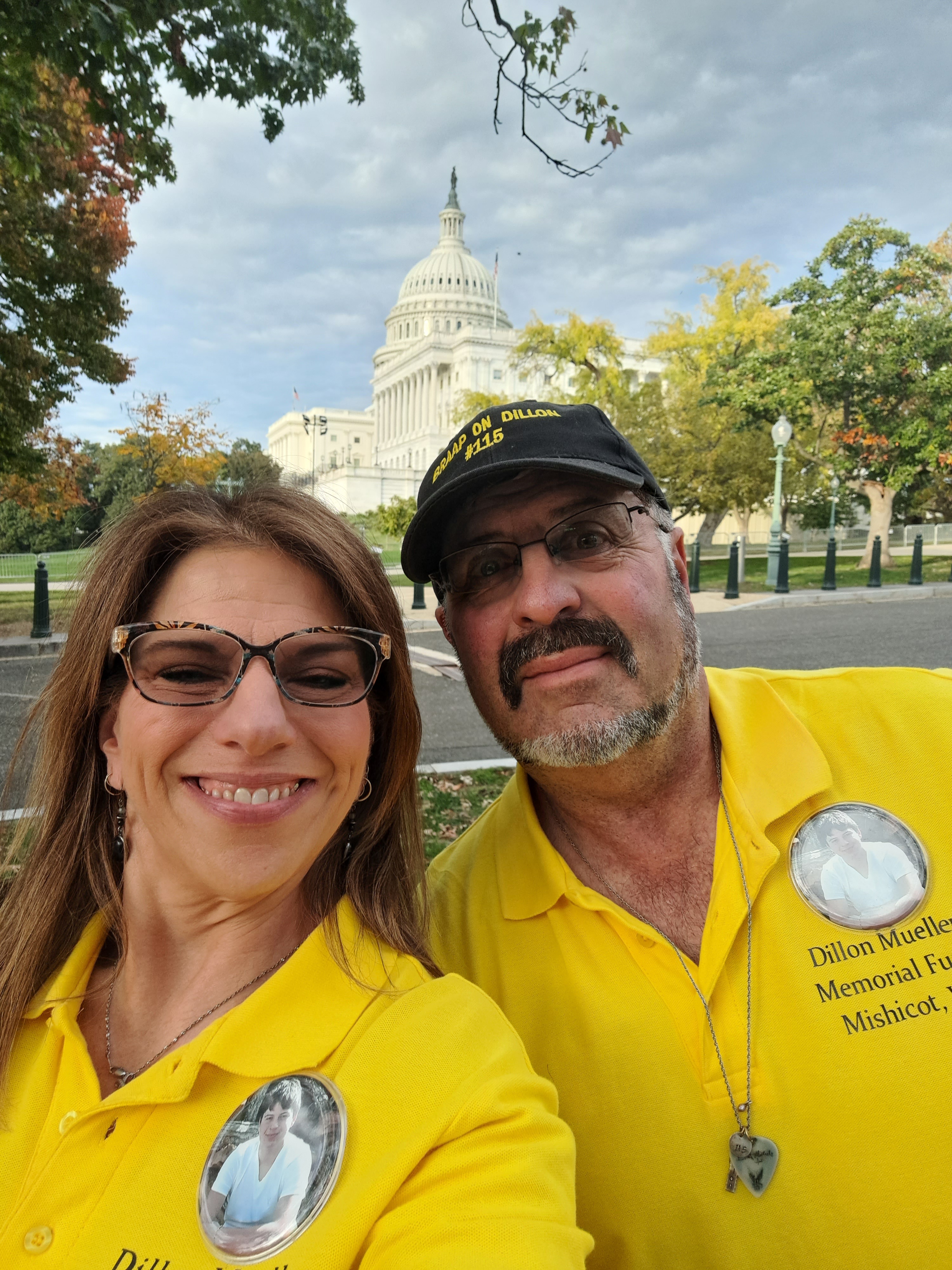
In October 2023, while traveling to the Washington, D.C. meetings with congress, Angel and George also presented educational classes about anaphylaxis and the emergency use of epinephrine auto-injectors to osteopathic medical students in Chicago, New York and Tennessee.
In October 2023, Angel & George Mueller took an amazing trip to Washington, D.C. where they had the opportunity to speak with 33 different congressional offices. These congress members all serve on the Energy & Commerce Health Subcommittee that ultimately votes on Dillon’s Law (Bill HR 3910) which incentivizes states to support Dillon’s Law nationwide! They were especially grateful to meet with the bill’s co-sponsors, Congressman Glen Grothman (WI) and Congresswoman Debbie Dingell (MI). The Mueller’s were joined by Kenny Mendez, CEO & President of the Allergy & Asthma Foundation of America and Jenna Riemenschneider, Sr. Director of Advocacy and Policy. The endorsement and support of this national organization offered additional strength to the conversations.
“Because of a bee sting, Dillon Mueller’s life was cut short. Since then, I have worked alongside Dillon’s parents to ensure no other family suffers this same tragedy.
In @EnergyandCommerce, I detailed “Dillon’s Law,” which will increase availability of EpiPens to help save lives.”
MANITOWOC – While Wisconsin has done the work to increase access to epinephrine statewide through laws named after Angel Mueller’s son, Mueller is now pushing to see the entire nation increase access to the life-saving medication.


 Dillon Mueller Memorial Fund